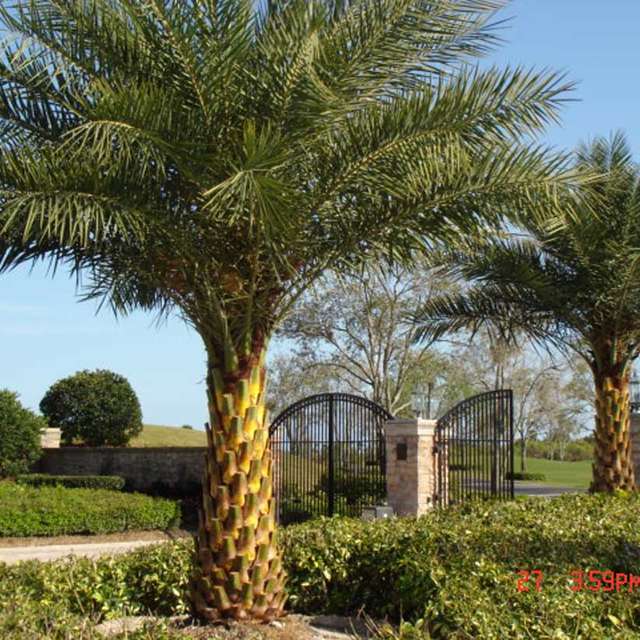
Homeowners and landscape designers researching date palms often run into three names that get compared to one another: the Sylvester palm, the Canary Island date palm, and the Medjool date palm. All three belong to the Phoenix genus and share a family resemblance, but they differ enough in size, appearance, and growing habit that choosing the right one matters for how a landscape looks and performs over time.
Sylvester Palm (Phoenix Sylvestris)
The Sylvester palm — also called the India date palm or silver date palm — is known for its slender, elegantly tapered trunk with a distinctive diamond cross-hatch pattern left by the base of old frond stems. Its fronds have a silvery-green cast, which is where the “silver date palm” name comes from. It’s notably cold-hardy, tolerating temperatures below 20°F, and it’s disease- and pest-resistant with good wind tolerance — traits that make it a strong fit for landscapes that need to hold up to Florida’s weather swings. The Robusta variety we grow at Sylvestris Tree Farms carries a larger caliper, more silver frond coloring, and a fuller head than standard sylvestris.
Canary Island Date Palm (Phoenix Canariensis)
The Canary Island date palm is the biggest of the three, with a thick, heavily textured trunk and a large, dense, symmetrical crown of fronds. It reads as a bold, statement specimen — often used as a singular focal point rather than in groupings, given its scale. It generally has less cold tolerance than the Sylvester palm, which is a consideration for landscapes in areas that see occasional hard freezes.
Medjool Date Palm (Phoenix Dactylifera ‘Medjool’)
The Medjool is the variety most associated with commercial date fruit production, and it has a straighter, more uniformly cylindrical trunk than the Sylvester palm’s tapered form. It tends to grow taller with a more upright silhouette, and it’s often chosen for formal, symmetrical landscape layouts — think matched rows along a boulevard or entrance drive.
Choosing the Right Palm for Your Project
The right choice comes down to what you need from the tree. If cold-hardiness, disease resistance, and a more slender, elegant silhouette matter most, the Sylvester palm is a strong choice — particularly for landscapes in areas that see real winter weather. If you want the biggest possible statement piece and cold isn’t a major concern, the Canary Island date palm delivers scale. If a tall, formal, uniform look is the goal, the Medjool fits that role well.
See Sylvester Palms in Person
Photos only tell part of the story with a specimen palm — trunk texture, frond color, and overall form are best judged in person. Visit Sylvestris Tree Farms in Vero Beach and walk the rows to see our field-grown Sylvester palms up close, or learn more on The Palms page. Ready to move forward? Contact us for pricing and availability.